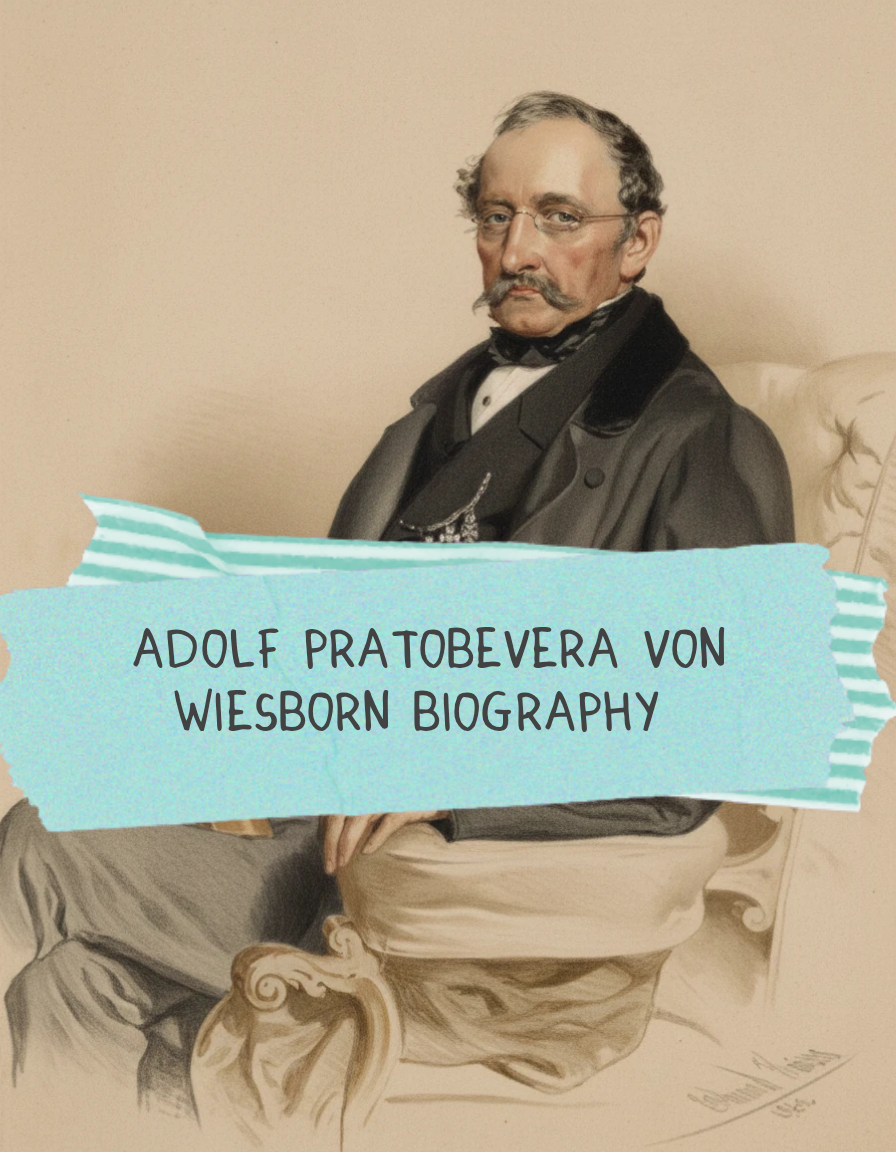
Adolf Pratobevera von Wiesborn Biography
Adolf Pratobevera von Wiesborn was a well known Austrian jurist, civil servant, and politician who played a key role in the legal and constitutional developments of the mid-19th century Habsburg Empire. Born into a noble family with deep roots in the Austrian administration, he rose through the ranks of the bureaucracy and later entered parliamentary politics. His contributions to justice reforms and the February Constitution of 1861 helped shape a more liberal framework during a period of significant political transition in Austria.
Throughout his career, Pratobevera von Wiesborn balanced administrative duties with political engagement. He served in various high-level positions, including as Austrian plenipotentiary in Frankfurt and briefly as Justice Minister. An artistically inclined individual, he also wrote poems, some of which were set to music by Franz Schubert, and authored works on legal and political topics. His life reflected the challenges and opportunities of the era, from the conservative restoration after the Napoleonic Wars to the constitutional experiments of the 1860s.
Full Name: Adolf Freiherr Pratobevera von Wiesborn (also known as Adolf Freiherr von Pratobevera-Wiesborn or Adolph Pratobevera von Wiesborn).
Place of Birth: Bielitz (now Bielsko-Biała, Poland), then part of Austrian Silesia.
Nationality: Austrian (citizen of the Austrian Empire and later Cisleithania).
Adolf Pratobevera von Wiesborn Early Life
Adolf Pratobevera von Wiesborn was born on June 12, 1806, in Bielitz, Austrian Silesia. He grew up in a family with strong ties to the Austrian legal and administrative system. His father, Carl Joseph Pratobevera (later elevated to Freiherr von Wiesborn in 1838), was a respected jurist who served as vice-president of the Lower Austrian Court of Appeal, member of the Court Commission on Justice Affairs, and even rector of the University of Vienna. This environment provided young Adolf with early exposure to law, governance, and intellectual pursuits.
The family background combined noble status with professional achievement in public service. Growing up in the early 19th century, Adolf witnessed the aftermath of the Napoleonic Wars and the conservative order established by the Congress of Vienna. These historical events influenced the political climate in which he would later operate. His upbringing emphasized education, duty to the state, and cultural refinement, qualities that marked his entire life. The Pratobevera family maintained a home in the Vienna area, including Maria Enzersdorf, which became a center for their social and intellectual activities.
Adolf Pratobevera von Wiesborn Age
Adolf Pratobevera von Wiesborn lived for 68 years. He was born in 1806 and passed away in 1875, spanning a transformative period in European and Austrian history. His active career covered the Vormärz era, the revolutions of 1848, the neo-absolutist period under Emperor Franz Joseph I, and the constitutional reforms of the 1860s. He reached the height of his political influence in his mid-50s, serving as Justice Minister at age 54-56. Even after retiring from some roles due to health issues, he remained engaged in public life until his later years.
Adolf Pratobevera von Wiesborn Education
Pratobevera von Wiesborn received a thorough legal education at the University of Vienna, one of the leading institutions in the Habsburg Empire. He completed his studies in law by 1828 and earned his doctorate in jurisprudence (Dr. jur.) in 1830. The University of Vienna at that time offered a rigorous curriculum focused on Roman law, canon law, and the Austrian legal system, preparing graduates for careers in the civil service or judiciary.
His academic training equipped him with the analytical skills and knowledge necessary for high-level administrative and political roles. He is remembered as a notable alumnus of the Faculty of Law and State, with his name appearing on a commemorative plaque unveiled in 1893 in the university’s main building. This recognition highlights the respect he earned through his scholarly foundation and subsequent achievements.
Adolf Pratobevera von Wiesborn Career
Pratobevera von Wiesborn entered public service shortly after completing his studies. In 1828, he began working in the Kammerprokuratur, a body handling fiscal and administrative legal matters. From 1832 to 1837, he served in the Staatsrat, the imperial council advising the monarch on state affairs. These early positions built his expertise in bureaucratic procedures and imperial governance.
A significant phase of his career came from 1838 to 1842, when he acted as the Austrian plenipotentiary at the Federal Central Authority in Frankfurt am Main. He even presided over this body at times, representing Austrian interests within the German Confederation. This diplomatic and administrative role exposed him to interstate relations and federal structures in the German-speaking world.
Returning to Austria, he contributed substantially as section chief in the Ministry of Justice. He played a major part in drafting the important Justice Laws of 1850, which modernized aspects of the judicial system during the neo-absolutist period. In 1847-48, he held an honorary position as secretary to Archduke Johann, who served as curator of the Austrian Academy of Sciences.
His parliamentary career began in 1861 when he was elected to the House of Deputies (Abgeordnetenhaus). That same year, on February 6, he was appointed Justice Minister in the Ministry of Archduke Rainer, receiving the title of Geheimrat (Privy Councillor). Working closely with State Minister Anton von Schmerling, he helped craft the centralist February Constitution of 1861. This document aimed to establish a more representative system while maintaining imperial unity.
As Justice Minister, Pratobevera supported liberalizing measures, including the Protestant Patent of 1861 and laws from October 1862 protecting personal freedom and home rights. These reforms marked steps toward greater individual liberties in the empire. However, he resigned in December 1862 due to an eye ailment. After successful surgery in 1864, he returned to political activity but broke openly with Schmerling in December 1864, contributing to the eventual fall of the ministry in 1865.
Pratobevera emerged as a leading figure among “constitutionally loyal” deputies. He opposed Prime Minister Richard Belcredi’s policies and hosted conferences in his home in January 1867 for deputies skeptical of compromises with Hungary. In February 1867, he became Landmarschall (provincial governor or chief administrator) of Lower Austria. Though he led opposition efforts, he ultimately voted in favor of the Austro-Hungarian Compromise of 1867, prioritizing stability.
In September 1869, he resigned his seat in the House of Deputies but was appointed to the House of Lords (Herrenhaus) in December of that year. He stepped down as Landmarschall in 1870. Beyond politics and law, he showed artistic talent and served as the first president of the Association for Regional Studies of Lower Austria from 1864 to 1874, promoting local history and culture.
His career reflected dedication to the Austrian state, balancing central authority with emerging constitutionalism. He navigated complex political shifts, from absolutism to dualism, always grounded in legal principles.
Adolf Pratobevera von Wiesborn Achievements
Pratobevera von Wiesborn left a lasting mark on Austrian legal and political history. His involvement in the 1850 Justice Laws advanced judicial organization. As Justice Minister, his role in the February Constitution of 1861 was central to introducing a limited parliamentary system. He contributed to key liberal reforms, such as protections for personal freedom and property rights.
In cultural spheres, he authored several works. These include “Einige Worte über die Gefängnissfrage” (1845 or 1848), discussing prison reform; “Zur Erinnerung an Karl Joseph Freiherrn von Pratobevera-Wiesborn” (1854), a memorial to his father; and “Silhouetten aus dem österreichischen Reichstage” (1862), offering insights into parliamentary life.
Artistically, he wrote poetry. One notable text, “Abschied von der Erde” (Farewell to the Earth), was set to music by Franz Schubert as D. 829, linking him to the great composer. His leadership in the regional studies association fostered preservation of Lower Austrian heritage.
He received several honors, including the Grand Cross of the Austrian Order of Franz Joseph, the Order of Leopold, the Prussian Red Eagle Order (3rd Class), and the Commander’s Cross of the Hessian Order of Merit. His name on the University of Vienna’s commemorative plaque underscores his academic and professional legacy.
Adolf Pratobevera von Wiesborn Recent News
As a historical figure who died in 1875, Adolf Pratobevera von Wiesborn does not generate current news. However, his life and contributions occasionally appear in academic discussions, historical publications, and exhibitions on 19th-century Austrian politics and law. References to him surface in studies of the Habsburg Empire’s constitutional development, the 1860s reforms, and Schubert’s song texts. Archival materials from the family, including diaries and documents, continue to interest researchers exploring noble and bureaucratic life in the empire.
Adolf Pratobevera von Wiesborn Personal Life
Pratobevera von Wiesborn was known for his artistic gifts alongside his professional rigor. He maintained an interest in literature, poetry, and regional culture. Health challenges, particularly an eye condition in the early 1860s, forced temporary withdrawal from office, but he recovered and resumed activity. He lived primarily in Vienna and the surrounding areas, engaging in both official duties and private intellectual pursuits. His home hosted political discussions, reflecting his role as a connector among like-minded figures.
He belonged to the Constitutional Party and advocated for a unified Austrian state while engaging pragmatically with the realities of the Austro-Hungarian Compromise. His life combined public service with cultural refinement, typical of educated nobility in the Habsburg era.
Adolf Pratobevera von Wiesborn Family
Adolf Pratobevera von Wiesborn came from a distinguished family. His father, Carl Joseph Freiherr von Pratobevera-Wiesborn (1769–1853), was a prominent jurist and administrator. His mother was Johanna von Pratobevera (née Schrötter). The family received noble elevation, enhancing their status.
He had siblings, including sisters such as Maria Edle von Bergmann. Records indicate he had daughters, including Adele Freifrau von Doblhoff-Dier and Maria Adolfine. The Pratobevera family maintained extensive archives with personal documents, legal papers, sketches, poems, and correspondence, illustrating a rich family life blending public duty and private creativity. They owned property in areas like Maria Enzersdorf near Vienna.
Adolf Pratobevera von Wiesborn Net Worth
No reliable public information exists on the net worth of Adolf Pratobevera von Wiesborn. As a 19th-century noble civil servant and politician, his wealth likely derived from family estates, salaries from high offices, and possible inheritances. Austrian nobles of his rank often held properties and enjoyed comfortable but not extravagant lifestyles tied to state service rather than commerce. Historical biographies do not detail personal finances, focusing instead on his professional and political contributions.
Conclusion
Adolf Pratobevera von Wiesborn exemplified the dedicated jurist and statesman of the late Habsburg Empire. From his early legal training to high ministerial office and parliamentary service, he helped guide Austria through critical reforms. His work on justice laws and the 1861 constitution advanced legal modernization and constitutional governance. Beyond politics, his literary and cultural contributions, including poetry linked to Schubert and leadership in regional studies, revealed a multifaceted personality.
He navigated turbulent times with pragmatism, supporting central institutions while adapting to political changes. His legacy endures in Austrian legal history and studies of 19th-century Central European politics. Pratobevera von Wiesborn represents a bridge between traditional imperial administration and emerging liberal structures, leaving an imprint on the empire’s development in its final decades.
FAQs
Who was Adolf Pratobevera von Wiesborn?
Adolf Pratobevera von Wiesborn was an Austrian jurist, civil servant, and politician who served as Justice Minister in 1861-1862 and contributed to key constitutional and legal reforms in the Habsburg Empire.
When and where was Adolf Pratobevera von Wiesborn born?
He was born on June 12, 1806, in Bielitz, Austrian Silesia (present-day Bielsko-Biała, Poland).
What were Adolf Pratobevera von Wiesborn’s main achievements?
His main achievements include helping draft the 1850 Justice Laws, co-creating the February Constitution of 1861, supporting liberal reforms as Justice Minister, and serving as president of the Association for Regional Studies of Lower Austria. He also wrote political and memorial works and provided a text set by Franz Schubert.
Did Adolf Pratobevera von Wiesborn write poetry?
Yes, he was poetically inclined. One of his texts, “Abschied von der Erde,” was composed by Franz Schubert.
When did Adolf Pratobevera von Wiesborn die?
He died on February 16, 1875, in Vienna, Austria.
What positions did Adolf Pratobevera von Wiesborn hold in government?
He held roles such as plenipotentiary in Frankfurt, section chief in the Ministry of Justice, Justice Minister, member of the House of Deputies and House of Lords, and Landmarschall of Lower Austria.
Was Adolf Pratobevera von Wiesborn involved in the Austro-Hungarian Compromise?
Yes, he participated in related discussions and ultimately voted in favor of the 1867 Compromise after leading some opposition efforts as a constitutional loyalist.